


The Damage of Resentment – Learn to Let Go
 What was the resentment trying to tell us?
Letting Go of Resentment
Sometimes, as we journey through life, things happen. Well actually Life happens.
We experience disappointment, betrayal, rejection and loss. We carry responsibilities we never expected to carry and burdens we never imagined would be ours. Sometimes we carry them quietly, without telling anyone quite how heavy they have become.
Then, when we look back, we may realise that there were people who should have been there. Someone who should have helped, or perhaps, someone who should have listened. Or indeed, someone who should have stood beside us when things became difficult.
Perhaps they could have shared the burden, but they didn’t. Instead, it may appear that they walked away. Or perhaps they simply failed to understand what we needed, and sometimes, more painfully, perhaps they understood perfectly well and chose not to be there anyway.
Those experiences leave their mark. We remember not only what happened, but who wasn’t there when it happened, and somewhere between the hurt and the memory of that hurt, resentment can begin to grow.
When Hurt Becomes Resentment
Resentment rarely arrives announcing itself. It grows quietly. We replay the conversation, we remember what someone said, and we remember what they didn’t say. We imagine what they should have done differently.
They should have helped me. They should have known. After everything I did for them, they should have been there, and perhaps they should have.
One of the things I would say differently today than I might have said years ago is that not all resentment is irrational.
Sometimes we have every reason to be angry, and sometimes we were treated unfairly.
Sometimes somebody really did betray our trust, take advantage of our kindness or abandon us at precisely the moment we needed them.
We do not heal by rewriting those experiences into something more comfortable. But there is an important distinction between acknowledging what happened and continuing to live inside what happened. The event may have lasted an hour, a day or a year.
Our resentment can keep it alive for decades.
The Stories We Continue to Tell Ourselves
The human mind is a wonderful storyteller. Unfortunately, it is also extraordinarily good at repeating the same story, as well as embellishing that story and creating an entire new story.
In an attempt to embed the thought of disempowerment, our mind will run the tape again, reconstruct the argument. We imagine the conversation we wish we had had and we finally say the perfect thing we couldn’t think of at the time. Every time we replay it, the story solidifies into the formed narrative and the past, sometimes embellished, briefly becomes the present again.
Our body doesn’t necessarily know that the argument happened ten years ago. The anger rises. Our heart beats faster, muscles tighten, and we feel the injustice again. Nothing outside us has changed. But inside us, the event has happened one more time.
There is perhaps one of the great paradoxes of resentment. We continue to give emotional space to someone we may no longer even want in our lives. They may have moved on years ago. Yet there they are, still occupying a room in our mind.
Anger Is Not the Enemy
I used to think that anger itself was something we needed to overcome, now I see it differently. Anger is part of being human.
Sometimes anger tells us that a boundary has been crossed. Sometimes it tells us that something matters deeply to us. Sometimes it is the voice that finally says:
Enough.
There is nothing inherently wrong with that. The difficulty comes when anger stops being information and becomes somewhere we live.
Resentment can give us a strange sense of protection. If I remain angry with you, perhaps you can never hurt me again. If I hold tightly enough to what you did, perhaps I can make sure I am never vulnerable in that way again.
But eventually we have to ask – Who is carrying the weight of that protection?
Usually, we are. Letting go does not mean saying that what happened was acceptable. It means deciding that what happened then will not be allowed to determine who I am now.
Forgiveness Is Not the Same as Reconciliation
I think this distinction matters enormously. We sometimes speak about forgiveness as though it requires reconciliation. It Does Not.
We can forgive someone and still decide that they no longer belong in our life. Allowing us to understand someone’s behaviour without excusing it, and we can release our anger without restoring our trust. Sometimes the healthiest boundary we can establish is distance.
There are also experiences for which the word forgiveness may simply feel impossible.
Perhaps, then, we don’t need to force it. Maybe the first step is something quieter. – I will no longer allow what you did to occupy so much of me. That alone can be an extraordinary act of freedom.
Looking at Our Own Part — Without Blaming Ourselves
There is another uncomfortable aspect of resentment. Eventually, we may need to look at ourselves. Not to take responsibility for another person’s behaviour. Their choices belong to them. But we can ask ourselves really important questions.
Why did I tolerate this for so long?
What prevented me from saying no?
Why did I keep returning, knowing the outcome?
Where did the fear develop that I was so afraid of disappointing someone who seemed perfectly comfortable disappointing me?
These are not questions of blame. They are questions of understanding.
Because once we understand the patterns that kept us somewhere painful, we have a much greater chance of recognising them the next time they appear, and perhaps part of forgiveness is also forgiving ourselves for what we didn’t know then.
We made choices with the understanding, confidence, circumstances and emotional resources we had at the time. Today, perhaps we would choose differently. That is not failure. That is growth.
Choosing What We Carry Forward
We cannot change the past. I know that sounds painfully obvious, but much of our emotional suffering comes from arguing internally with precisely that fact.
It shouldn’t have happened.- Perhaps it shouldn’t.
They shouldn’t have treated me like that. – Perhaps they shouldn’t.
They should have been there.- Perhaps they should have bean, but they weren’t.
Eventually we arrive at a choice. Not a choice about what happened. That choice has already been taken from us. The choice we still possess is what we carry forward from it.
We can carry the bitterness, or we can carry the wisdom. We can carry the betrayal or we can carry a better understanding of boundaries.
We can carry the rejection, or we can allow it to teach us that our worth was never dependent upon somebody else’s ability to recognise it.
Sometimes we will carry a little of all of them. Because we are human.
Some Thoughts on Letting Go
When you notice resentment returning, don’t immediately judge yourself for feeling it. Instead, become curious about it.
Ask yourself:
- What am I actually angry about? Sometimes the event we keep replaying isn’t the real wound underneath it.
- Am I remembering the past as it happened or an embellished version? This is important.
- Am I remembering the past or reliving it? There is an enormous difference
- Is there something I still need to say or do? Perhaps a boundary needs to be established. Perhaps a conversation needs to happen. Or perhaps the conversation needs to happen only within ourselves.
- What does holding onto this give me? Protection? Identity? A sense of justice? The hope that eventually someone will admit they were wrong?
- What is it costing me? Peace? Relationships? Sleep? Happiness? The ability to trust?
- Do I need forgiveness, or do I simply need release? They are not necessarily the same thing.
- What have I learned? Not because everything happens for a reason. I am no longer convinced that it does, but because even painful experiences can leave us wiser if we allow them to.
And finally. – Who would I be if I no longer needed to carry this? That may be the most important question of all.
Be Your Heart
Letting go of resentment isn’t about becoming passive, it isn’t about pretending that people haven’t hurt us, it isn’t about allowing someone to cross our boundaries again in the name of forgiveness, and it certainly isn’t about denying anger, sadness or disappointment.
To be fully human is to experience all of these things.
But perhaps being fully human also means recognising that we are more than the things that happened to us.
The past can inform us without imprisoning us. Anger can protect us without defining us. Forgiveness can be offered without reconciliation, and sometimes letting go isn’t something we do for the person who hurt us at all.
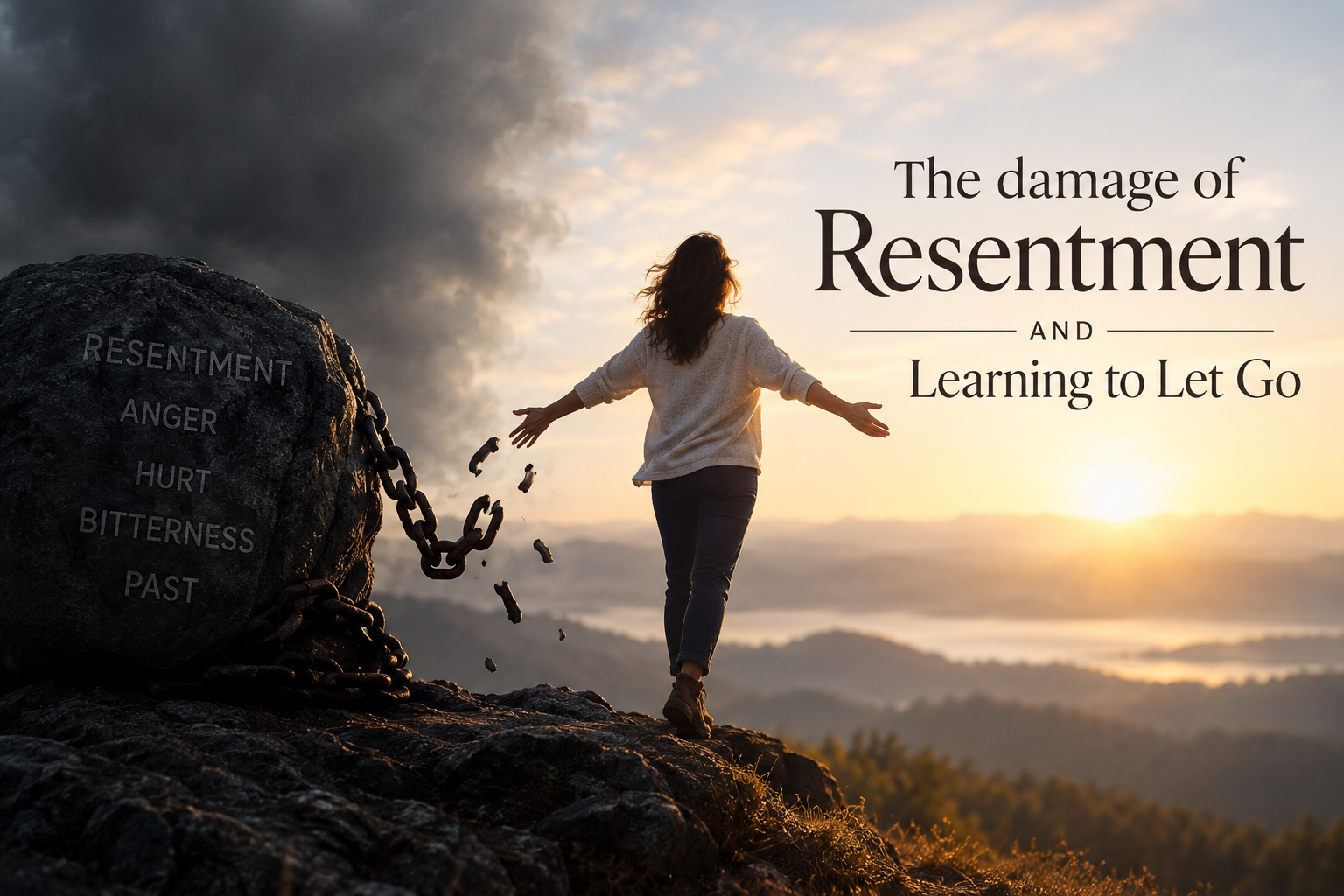
It is something we do because eventually we realise. – I have carried this long enough. Remember what happened. Learn from it. Protect the boundaries it taught you to build, and when you are ready, put down what you no longer need to carry.
Acknowledge the hurt. Keep the wisdom. Release the resentment.
Choose to Be Your Heart.


