


What Does Real Strength Look Like – For Men?
What Does Real Strength Look Like – For Men?
What does real strength look like – For Men? Seeking inner strength in a world that has forgotten what true power and strength mean is a challenge, to say the least. In a world where confidence is often mistaken for arrogance, dominance is celebrated as leadership, and social media rewards outrage over understanding, the answer has become surprisingly difficult to recognise.
Recently I watched two television programmes that genuinely unsettled me. Neither was about war, politics or economic collapse. Both were about something far closer to home: the struggle to understand what it means to become a man in today’s world.
Adolesence
The first programme I watched was Adolescence. It brought me to tears. The story follows a young boy desperately trying to discover who he is in a world where identity is increasingly shaped by social media, online influencers, peer approval and impossible expectations. He isn’t portrayed as inherently evil, but as vulnerable, confused, isolated and gradually pulled into a digital culture that distorts his view of himself, relationships and what it means to be a man. He is a thirteen-year-old boy trying to understand how to become a man.
Adolescence holds a mirror up to modern society. It asks how a child searching for acceptance and belonging can become lost in an online world that rewards anger, status and division while leaving parents, teachers and friends unaware of what is really happening beneath the surface. It is less a crime drama than a cautionary story about a generation growing up in a world where the loudest voices are often the least responsible, and where a young person’s need to fit in can have devastating consequences.
The Manasphere
The other programme was The Manosphere. In many ways, it helps explain what happened to the boy in Adolescence. The manosphere is a collection of online communities centred on masculinity, relationships and male identity and, in my opinion, some of its more influential voices give young men permission to become bullies.
While some areas focus on self-improvement and personal responsibility, researchers have documented that influential parts of the manosphere promote rigid gender roles, hostility towards women and narratives of male victimhood. These communities often attract young men searching for identity, purpose or belonging, offering simple explanations for complex emotional and social challenges. Social media algorithms can reinforce these messages by repeatedly recommending similar content, creating echo chambers in which increasingly extreme ideas become normalised.
The greatest concern is not that every young man exposed to the manosphere becomes radicalised, but that prolonged immersion can shape attitudes during formative years. Studies of online radicalisation have found that repeated exposure to grievance-based communities can increase acceptance of misogynistic beliefs, reduce empathy for those outside the group and encourage an adversarial view of relationships between men and women.
Rather than helping young men develop resilience, emotional intelligence and healthy relationships, the more extreme voices often frame strength as dominance, vulnerability as weakness and cooperation as surrender. In doing so, they risk replacing personal growth with ideological certainty, leaving some young men less equipped—not more—to thrive in modern society.
Positive Self – Development
There is nothing wrong with men seeking to become stronger, healthier, wiser or more successful. Self-improvement has always been one of humanity’s greatest virtues. The problem begins when personal growth is replaced by a philosophy that measures success through dominance over others or teaches that one group can only prosper by diminishing another.
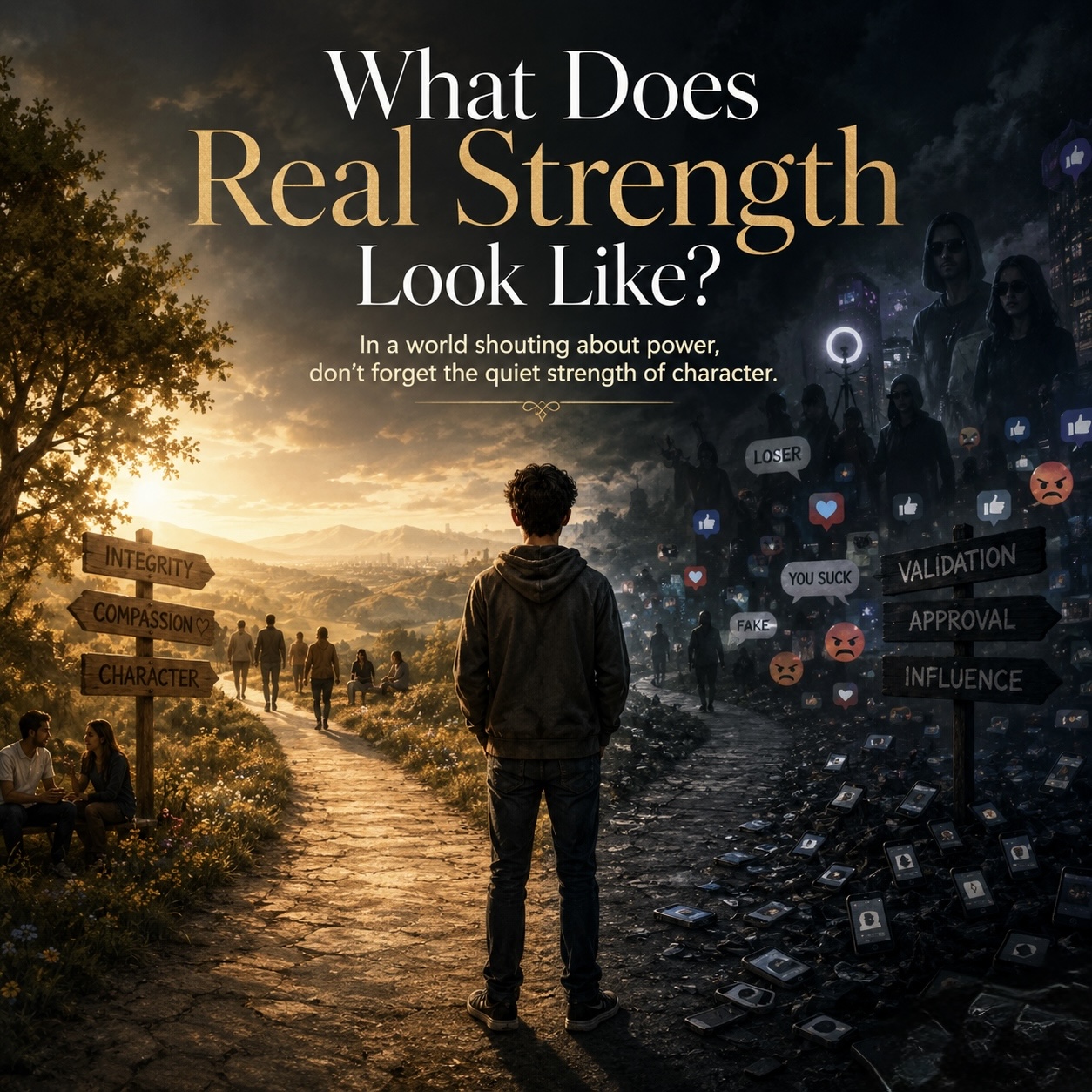
Genuine strength is not demonstrated by belittling women or any other human being, mocking vulnerability or treating compassion as weakness. Genuine strength—real strength—is demonstrated by character, integrity, honour, humility and the ability to lift others without diminishing yourself.
Some people see me as foolish because of my kindness. I have learned that says far more about them than it does about me.
This principle extends far beyond the manosphere. Any ideology that encourages us to view another human being as inferior because of gender, race, sexuality, nationality, religion or belief ultimately weakens society rather than strengthening it.
Human progress has always depended upon cooperation, mutual respect and our capacity to recognise the dignity of every individual. The strongest people are rarely those who shout the loudest or claim superiority over others. They are those whose confidence allows them to respect others while remaining true to themselves.
Reflection
As a boy, I was quiet, and for very good reason. At the age of ten I prayed to God that He would fix me. I had no idea what was wrong with me and therefore no idea how I could be fixed. By the age of twelve I cried myself to sleep, worrying about what the future would hold for a boy like me. I hid my sexuality until I was thirty years old.
Eventually, I fell in love and married the most amazing man. On our wedding day I wept as I remembered that frightened twelve-year-old who believed he would spend his life alone. Yet there I was, surrounded by more than one hundred family members and friends, marrying the man I loved. How blessed I was to survive.
There was a time when I believed success looked like bigger businesses, better cars, tailored suits and continual achievement. Eventually I discovered that the pursuit itself never delivered what I believed it would. The day I realised I already had enough was the day success began to mean something entirely different.
There is an old saying:
“He is richest who is content with the least.”
Not because poverty is desirable, but because once our basic needs are met, the endless pursuit of more can become a burden rather than a blessing.
Yet modern culture often teaches the opposite.
People have changed. I have changed. Yet I believe I have held onto the qualities my father taught me: Honour. Integrity. Love. They remain my compass.
The world we live in is filled with confusion, anger, entitlement and a relentless search for peace outside ourselves. Some believe wealth will bring peace. Others chase fame. In my experience, neither does.
Eventually many of us reach a point where the question is no longer, “What more can I achieve?” but “How do I want to spend whatever years remain?”
Guiding Principles
For me, life is guided by simple principles.
Honour.
Integrity.
Peace.
Respect.
Simplicity.
Loyalty.
Love.
Empathy.
They do not answer every question, but they have brought me closer to gratitude than anything I have ever owned.
I once believed strength and power were measured by success. Today I believe they are measured by character.
The strongest people are not those who dominate others. They are those who possess enough confidence to protect the vulnerable, enough wisdom to remain humble and enough courage to meet the world with kindness rather than anger.
If there is such a thing as inner peace, I believe it begins there.
Written by David Ellis


